Eric Ligon Reflects on 38 Years of Teaching, Leadership and Design at UNT CVAD
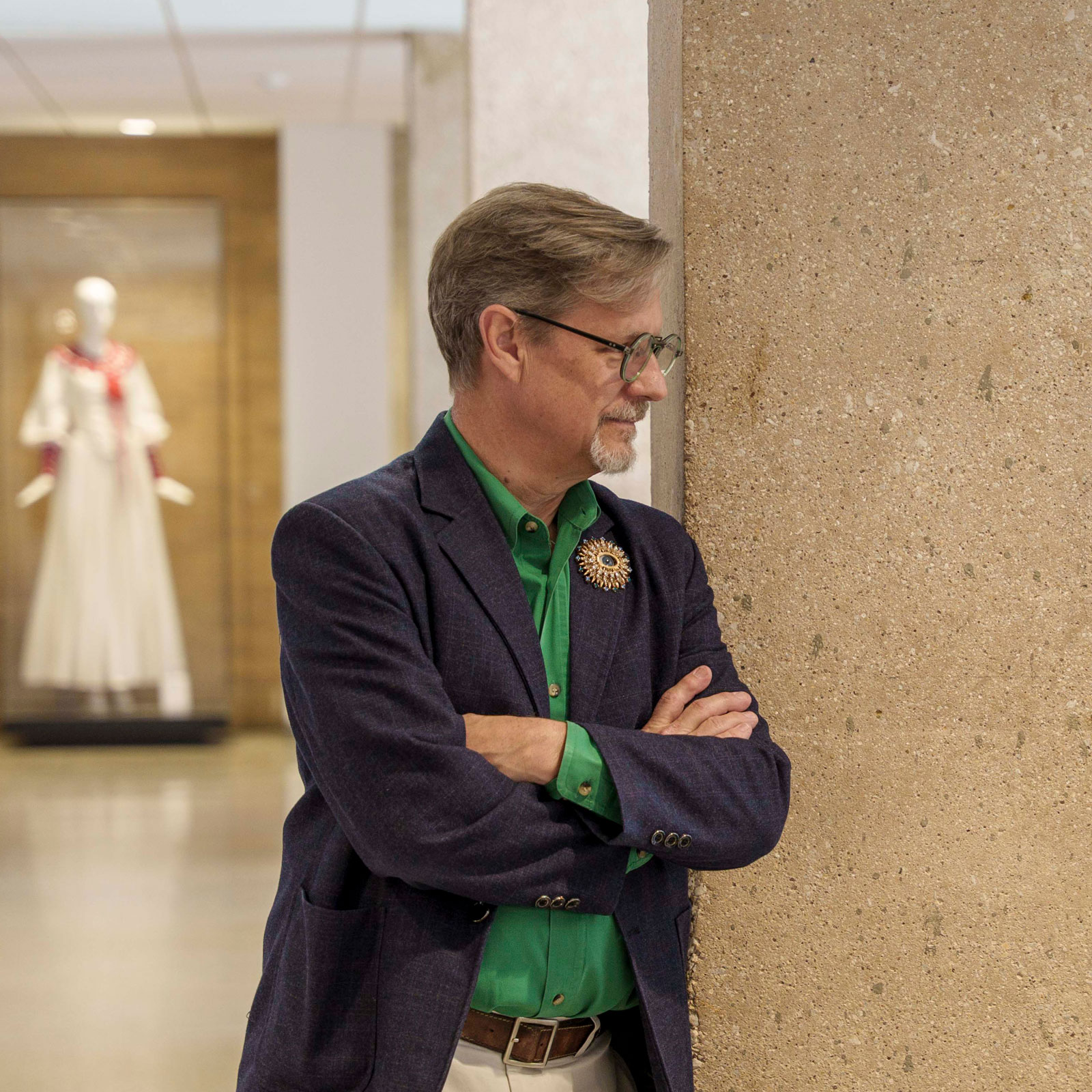
Eric Ligon
For nearly four decades, Eric Ligon has helped shape the culture and direction of the University of North Texas College
of Visual Arts and Design — first as a graduate student, then as a professor, mentor
and administrator.
As he retires May 31, 2026, after 38 years at UNT, colleagues and former students
remember him as a demanding typography professor, a thoughtful leader and someone
who believed deeply in the ability of design education to change lives.
When Ligon talks about his career, he rarely talks about himself first. Instead, he
talks about students, faculty colleagues and the Communication Design program he helped
build over the course of several decades.
One of the accomplishments he is most proud of is helping shape UNT’s nationally recognized
Communication Design program alongside longtime colleagues, including Professor Emeritus Jack Sprague and Professors Michael Gibson and Keith Owens.
true
"Distinguished University Professor Eric Ligon is known to generations of students
and alumni, as well as colleagues, as a faculty member dedicated to his students and
to their successes in life. His affiliation with students came naturally: as a graduate
of the M.F.A. program in Communication Design at UNT, he was one of them! He approached
his teaching as a designer helping others to become designers.
"In his nearly four decades at the university, he never lost track of them as individuals.
As a colleague and program coordinator for Graphic Design, he worked closely with
his colleagues in developing new programs, review processes, and classes that enabled
well over a thousand students to go through the graphic design programs. In his announcement
of his retirement, as always, his first words are for his students. That’s a focus
he maintained throughout his long career at UNT. Remarkable, really.
"I met Eric Ligon during the interviews when I came in as dean of the then-School
of Visual Arts at UNT. We were able to get the name changed to “College of Visual
Arts and Design” to recognize the strong design programs at the university and the
scale of the college operations. Eric Ligon was instrumental in that change and in
many other features that defined the college and university. He is a consummate faculty
member, dedicated to his field, his students, and the implementation of design thinking
not just in the classroom but throughout the university.
"For over a decade, he was largely responsible for the design of the university identity
system, working as a brand designer and consultant with the UNT System, developing
identity, stationery, and building signage as the system kept opening new branches,
while creating everything from fonts to mascots, stationery and signage for UNT buildings,
not to mention the CVAD website.
"People in the university always recognized Eric’s service and administrative skills.
He became the associate dean for the College and, after I left, the interim dean.
He carried his focus on students and CVAD forward, returning to his role as the senior
associate dean for Academic and Administrative Affairs for the college.
"I remember one day Eric came to my office with another new idea. After we talked,
he said, 'You know, I’ve found when I come in here with an idea, you say, 'Go ahead
— you should do that!'" One of his remarkable strengths was always doing what he
said he would do.
He’s an amazing father, husband, inveterate home remodeler, teacher, administrator
and colleague! I wish him, Leslie, Ethan and Nicholas a wonderful future!"
Eric, I asked AI to tell me some facts about you. It said your favorite Jane Austen
quote is "Gracious, don't let cillantro near that man!" I'm not so sure.
Regardless, cheers, my friend, the finest of innings by the finest of men.
“When I arrived, the department was a good department,” Ligon said, “but working with
terrific colleagues, we moved the bar and set the standard and are now recognized
as one of the best Communication Design programs in the U.S.”

Eric Ligon, left, accepts a porcelain vase, a retirement gift from the college, created
by Brooks Oliver, right, CVAD faculty and ceramic artist.
Ligon first came to Denton in 1988 to begin graduate studies in advertising art at
UNT, which at the time was still part of the College of Arts and Sciences. Before
Texas, he studied at Pratt Institute and worked professionally in New York, freelancing
for publications including “Interview” magazine and “Weight Watchers® Magazine,” while
also art directing for clients such as Barbie Magazine, JCPenney and Dr Pepper/7UP.
He began teaching during his first semester as a graduate student and quickly realized
the classroom was where he belonged.
“Teaching for me has been a gift and vocation, but never a job,” Ligon wrote in a
farewell message to alumni and colleagues.
After briefly leaving UNT to work professionally as an art director at Dr Pepper/Seven
Up, where he met his wife, Leslie, he returned in 1991 as an assistant professor in Communication Design. Over the
years, he became known for his typography courses and exacting attention to detail.
Former students still tell him they hear his voice while adjusting kerning or selecting
typefaces.
For Ligon, typography was never only about aesthetics. Learning to care about tiny
details, he believed, changed the way students approached all aspects of design.
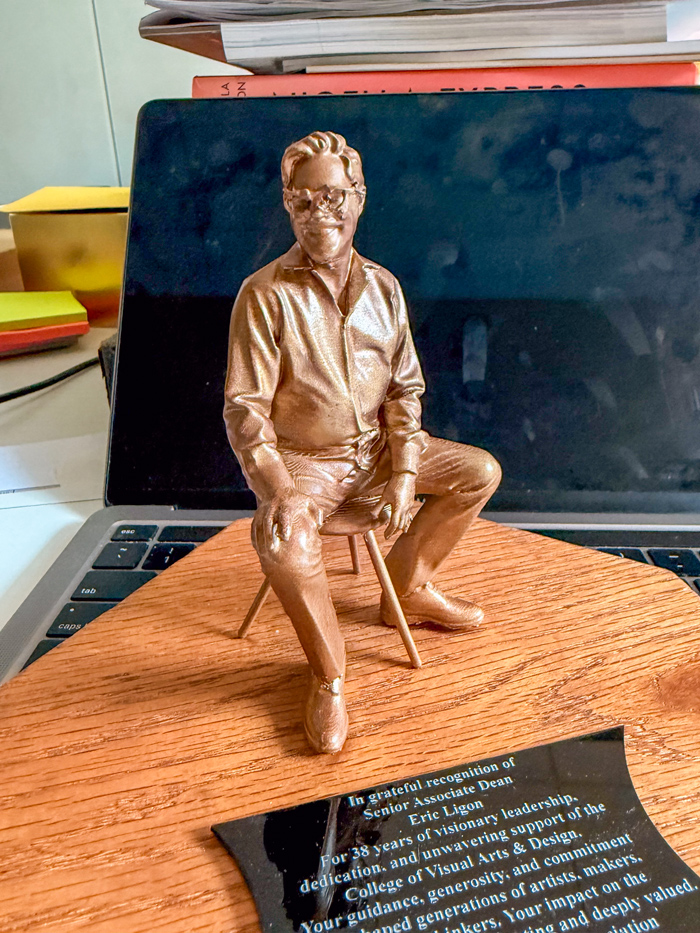
The Studio Art Visual Art Technicians presented Eric Ligon with a custom figurative
sculpture honoring his 38 years of leadership, mentorship and dedication to the UNT
College of Visual Arts and Design ahead of his retirement.
“Not only is typography unbelievably rich as a subject, if one is able to see at that
level of tiny detail — and to know that it is important to get even the space between
two tiny letters on a page correct — their attention to the design at all levels is
heightened,” he said.
In 2012, UNT recognized Ligon as a Distinguished Teaching Professor, an honor he described
as especially meaningful because teaching always mattered more to him than accolades
or research.
“It was always the students and their lives that mattered most to me,” he said.
Over time, his role at UNT expanded beyond the classroom. He served as coordinator
of the Communication Design program from 2004 to 2011 before moving into leadership
roles as associate dean, interim dean and senior associate dean for administrative
affairs.
Administration changed the way he saw the college.
“As a faculty member, I primarily saw the students,” Ligon said. “When I moved into
an associate dean role, my view expanded to encompass the faculty and staff — and
the facilities." Ligon worked on the five-year $70 million construction and renovation
of the UNT Art Building, which transformed it into a 238,000-square-foot building.
He said those years helped him better understand the many people required to sustain
an art and design college — from faculty balancing teaching and research to staff
members whose work often happens quietly behind the scenes in the state-of-the-art
facilities they need.
During Ligon’s time at UNT, the college itself transformed dramatically. What began
as a single art department evolved into the School of Visual Arts and eventually the
College of Visual Arts and Design, now one of the nation’s largest public art and
design colleges.
“Our enrollment in the Art Department when I arrived was maybe 1,200 students,” he
said. “A number of years ago, we became the largest college of art and design in a
public institution with enrollment over 2,800 students.”
Some of the most personal and influential works of Ligon’s career grew out of his
experiences as a father. His oldest son, Ethan, who is blind, inspired his interest in accessibility and inclusive design. The family
eventually moved back to Denton so Ethan could work with respected Braille educator
Diane Briggs in Denton ISD.

Braille bracelets designed by Leslie Ligon opened communication for sighted and Braille
readers.
As Ethan learned Braille, Eric and Leslie did too. They began practicing by writing
daily lunchbox notes for him to read at school. In 2002, Leslie began designing braille
jewelry. Her signature piece, the braille alphabet bracelet, was propelled by Eric’s
typography influence, and it gained popularity momentum in 2010, after winning the
Smithsonian/Cooper-Hewitt People’s Choice Award at the 2010 National Design Awards,
which culminated in a meeting with former First Lady Michelle Obama and educator Tim Gunn at the White House.
The lunchbox notes and shared reading experiences then sparked the idea for BrailleInk,
the nonprofit organization Ligon co-founded after developing a dual-use publishing
format integrating print and Braille onto the same page so blind and sighted readers
could read books at the same time. That project gained national attention and was
featured in People magazine, Lions Clubs International Magazine and numerous television,
radio and newspaper stories. As Ethan learned Braille, Ligon began writing lunchbox
notes in Braille for his son to read at school. The experience eventually led him
to create a new publishing format that integrated print and Braille on the same page
so blind and sighted readers could share books together naturally.
“It was pretty remarkable,” Ligon said. “One of the really exciting things we’ve done.”
Accessibility and communication also shaped his professional design work. Alongside
Owens, Ligon helped redesign the brand identities for UNT, UNT Dallas, UNT Health
Science Center, UNT System and UNT’s law school, as well as the City of Anna, Texas.
Still, when Ligon reflects on his career, he returns most often to students.
“You are my legacy,” he wrote to his former students. “The greatest privilege of my
career has been watching you become you.”
He often reminded former students that the rigor of the program — difficult critiques,
long nights and constant revision — helped build resilience beyond the classroom.
“All I’ve ever cared about is that you are happy in whatever it is you do,” he wrote.
Outside the classroom and administrative offices, family remained central to Ligon’s
life. His sons graduated from what the Ligons fondly call "the family business," their
name for UNT. Ethan graduated this year with an M.A. in Interaction Design, and his
brother, Nicholas, with a B.A. in Integrative Studies. Now, as Eric and his wife, Leslie, prepare to
move to North Carolina for retirement, Ligon looks forward to something simple after
decades devoted to the college: time together.

“You are my legacy,” he wrote to former students. “The greatest privilege of my career
has been watching you become you.”
Looking back, he admits he never expected Denton would become home.
“I never expected I’d find a home, let alone a family, when I drove into Denton all
those years ago,” he wrote. “I’ve been far luckier than I ever deserved.”
Asked what he hopes students, colleagues and alumni remember most about his years
at UNT, Ligon returns again to the belief that guided his entire career — that education
changes lives.
“I hope they remember the passion I had for the power of education to change lives,”
he said. “Even in really rough times, the gift of working with students is pretty
amazing and worthwhile. Always.”
For future generations of designers and artists, his advice remains both practical
and deeply personal: “Don’t take shortcuts. Details are always important and worth
the time. And loving it is the best you can offer.”
 University of North Texas

